Polish Food Glossary for Americans: 24 Names Explained, with Pronunciation, NYC
Walk into a Polish deli in New York and the labels can look like a spelling test: żurek, gołąbki, kabanosy. This glossary covers 24 names you will meet most often at the counter and the Polish table, with simple sound-alike pronunciation and a plain-English note on what each one is.
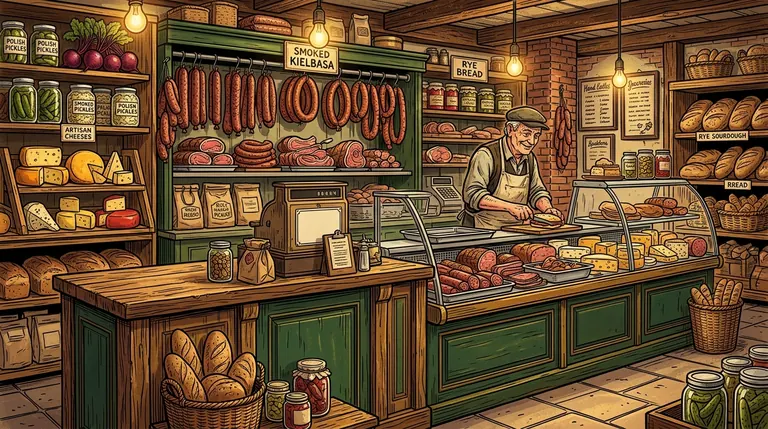
The Polish food names Americans meet most are pierogi (filled dumplings), żurek (sour rye soup), bigos (hunter's stew of sauerkraut and meat), gołąbki (stuffed cabbage rolls) and kabanosy (thin dry sausages). In New York City you can try them at Ranczo Polish Deli in Ozone Park, Queens, and Beata Deli in Valley Stream.
In this guide you will learn
- 24 Polish food names with simple English sound-alike pronunciation, grouped into soups, mains, deli meats, bakes and pantry
- Polish plurals: pierogi, kabanosy and gołąbki are already plural, so pierogis sounds odd to a Polish ear
- Each term comes with a short note on what is in it and how it is served
- Where to try them: Ranczo Polish Deli (Queens), Beata Deli (Valley Stream) and Pasztecik NYC products at both stores
How do you read the pronunciation guide?
The pronunciation in this glossary uses English sounds, so you can read it without knowing any Polish. Capital letters mark the stress, which in Polish almost always falls on the second-to-last syllable: pyeh-ROH-gee, kah-bah-NOH-sih. Get the stress right and most Polish words already sound much closer to the real thing.
The letters with tails and accents cause the most trouble. Ł sounds like an English w, so gołąbki is gaw-WOMB-kee. Ż and rz sound like the s in pleasure, and ą before b sounds like om. Sz and cz are just sh and ch, so the scary-looking szcz in barszcz is simply sh-ch said together.
Then there are plurals. Pierogi, kabanosy, gołąbki, paszteciki and chruściki are already plural, so pierogis is a double plural to a Polish ear. Everyone will understand you, but if you want to sound like a local, one dumpling is a pieróg, one sausage stick a kabanos, one cabbage roll a gołąbek.
Polish soups: żurek, barszcz, rosół, flaczki and ogórkowa
Żurek (ZHOO-rek) is a sour soup made on a fermented rye flour starter, usually with white sausage, a hard-boiled egg and marjoram; the tang comes from fermentation, not vinegar. Barszcz czerwony (BARSHCH) is a clear, slightly tart red beet soup, served on Christmas Eve with tiny mushroom dumplings. Rosół (ROH-soow) is golden chicken and vegetable broth with thin noodles – the Sunday classic in Polish homes.
Flaczki (FLAHCH-kee) is beef tripe soup in a peppery, marjoram-scented broth – a delicacy for some, a dare for others. Ogórkowa (oh-goor-KOH-vah) is dill pickle soup, tangy and filling, and much better than it sounds to American ears. You will find all of these at Beata Deli in Valley Stream, and soups from the Pasztecik NYC kitchen are sold at both stores in our network.
| Name | Say it like | What it is | Where in our network |
|---|---|---|---|
| pierogi | pyeh-ROH-gee | filled dumplings | Beata Deli; Pasztecik NYC at both stores |
| żurek | ZHOO-rek | sour rye soup | Beata Deli |
| barszcz czerwony | BARSHCH | red beet borscht | Beata Deli |
| bigos | BEE-gos | hunter's stew | Beata Deli |
| gołąbki | gaw-WOMB-kee | stuffed cabbage rolls | Beata Deli |
| flaczki | FLAHCH-kee | tripe soup | Beata Deli |
| kiełbasa | kyew-BAH-sah | sausage | Ranczo, Beata Deli |
| kabanosy | kah-bah-NOH-sih | thin dry sausages | Beata Deli |
| twaróg | TFAH-rook | farmer cheese | Beata Deli |
| paszteciki | pash-teh-CHEE-kee | filled yeast buns | Pasztecik NYC at both stores |
| makowiec | mah-KOH-vyets | poppy seed roll | Beata Deli |
| chruściki | hroosh-CHEE-kee | angel wing cookies | Beata Deli, Pasztecik NYC |
Main dishes: pierogi, gołąbki, bigos, kopytka and schabowy
Pierogi (pyeh-ROH-gee) are filled dumplings, boiled and often pan-fried with onion afterwards. Pierogi ruskie are filled with potato and farmer cheese – the name refers to the historic region of Red Ruthenia, not Russia. There are also meat, sauerkraut and mushroom, sweet cheese and fruit pierogi. Gołąbki (gaw-WOMB-kee) are cabbage leaves rolled around meat and rice and braised in tomato or mushroom sauce; the name literally means little pigeons.
Bigos (BEE-gos), or hunter's stew, is sauerkraut and fresh cabbage slow-cooked with meat, kielbasa and mushrooms; Poles say it is best on the third day. Kopytka (koh-PIT-kah) are potato dumplings cut into diamonds, and kluski śląskie (KLOO-skee SHLONS-kyeh), Silesian dumplings, are round potato dumplings with a thumbprint to hold gravy. Kotlet schabowy (SHAH-boh-vih) is a breaded pork cutlet, Poland's cousin of schnitzel.
Beata Deli cooks all of these daily, hot to eat in or take out. Pierogi from the Pasztecik NYC kitchen are also sold at Ranczo Polish Deli in Ozone Park, Queens – call +1 (917) 327-1210 to check what is in on a given day.
Deli meats and dairy: kielbasa, kabanosy, salceson and twaróg
Kiełbasa (kyew-BAH-sah) simply means sausage in Polish and covers dozens of kinds. Wiejska is a thick, smoked country sausage with plenty of garlic; krakowska sucha is a firm dry sausage sliced thin; jałowcowa is flavored with juniper; and biała, white sausage, is sold raw for simmering or roasting and belongs in żurek. Kabanosy (kah-bah-NOH-sih) are long, thin, dry-smoked pork sticks – the perfect snack.
Polędwica (poh-len-DVEE-tsah) is a delicate smoked pork loin cold cut, boczek (BOH-chek) is smoked bacon, and salceson (sahl-TSEH-son) is head cheese, small pieces of meat set in aspic. Twaróg (TFAH-rook) is fresh white farmer cheese, the base of pierogi ruskie and Polish cheesecake. You can buy deli meats at Ranczo Polish Deli, which gets deliveries on Wednesdays, Thursdays and Fridays, and at Beata Deli.
Bakes and sweets: pączki, chruściki, makowiec and paszteciki
Pączki (POHNCH-kee) are fluffy filled yeast doughnuts, famous on Fat Thursday before Lent. Chruściki (hroosh-CHEE-kee), also called faworki or angel wings, are thin, brittle ribbons of dough fried golden and dusted with powdered sugar. Makowiec (mah-KOH-vyets) is a rolled yeast cake with sweet poppy seed filling, and sernik (SER-neek) is Polish cheesecake made with farmer cheese – denser and less sweet than the New York kind.
Paszteciki (pash-teh-CHEE-kee) are savory filled yeast buns, great with a cup of borscht or as a quick lunch. They are made by the Pasztecik NYC kitchen in North Bellmore and sold at both stores in our network. Pączki, chruściki, makowiec and sernik are at Beata Deli; call ahead to check what is available on a given day.
The Polish pantry: pickles, sauerkraut and Kubuś
Ogórki kiszone (oh-GOOR-kee kee-SHOH-neh) are cucumbers fermented in salt brine with garlic and dill – no vinegar, which is why they taste different from American dill pickles. Kapusta kiszona is Polish sauerkraut, the base of bigos and Christmas Eve pierogi. Add mustard, Tymbark juice, Kubuś fruit purée drinks for kids, and E.Wedel and Mieszko chocolates.
All of these are on the shelves at Beata Deli in Valley Stream. If you are just getting to know Polish food, a basket of fermented pickles, kabanosy, sourdough bread and an E.Wedel chocolate bar makes a great first sampler – no cooking required, all real flavor.
For more practical details, see our related guides on guide to Polish delis in New York City, as well as where to buy authentic Polish kielbasa in NYC, as well as best pierogi in New York City, as well as traditional Polish soups, from żurek to dill pickle soup, as well as stuffed cabbage and bigos at Beata Deli.
How to Start Exploring Polish Food in New York
- Start with three classicsOn a first visit try potato and cheese pierogi, a bowl of żurek or red borscht, and a few kabanosy. It is the easiest way into Polish food.
- Point to the wordStaff speak Polish and English, but showing a word from this glossary makes ordering a specific dish easy.
- Add something sweetFinish with makowiec, sernik or chruściki. Call +1 (917) 327-1210 to check which bakes are in on a given day.
Key terms in this guide
- Żurek
- A tangy soup made on a fermented rye flour starter, usually with white sausage, egg and marjoram. Say it: ZHOO-rek.
- Bigos
- Hunter's stew: sauerkraut and fresh cabbage slow-cooked with meat, kielbasa and mushrooms, often reheated over several days. Say it: BEE-gos.
- Gołąbki
- Cabbage leaves rolled around a meat and rice filling and braised in tomato or mushroom sauce. Say it: gaw-WOMB-kee.
Frequently asked questions
What is żurek?
Żurek is a sour Polish soup made on a fermented rye flour starter, usually served with white sausage and a halved hard-boiled egg. Its tang comes from fermentation, not vinegar.
Is it pierogi or pierogis?
Pierogi is already plural in Polish; one dumpling is a pieróg. Pierogis is an American habit that Poles understand but do not use.
What is the difference between kielbasa and kabanosy?
Kielbasa simply means sausage and covers many types, from fresh white to smoked. Kabanosy are a specific thin, long, dry-smoked pork sausage eaten as a snack.
Where can I try Polish food in New York?
Ranczo Polish Deli at 93-04 101st Avenue in Ozone Park, Queens, and Beata Deli at 234 Rockaway Avenue in Valley Stream both carry Polish foods, including dishes from the Pasztecik NYC kitchen.
Visit Ranczo Deli in Queens or Beata Deli on Long Island
Both stores share one phone number: +1 (917) 327-1210. We speak Polish and English.
Keep reading
Guides related to this topic.
Wigilia Explained: The 12 Dishes of Polish Christmas Eve and Where to Buy Them in NYC
Why Polish Christmas Eve has 12 dishes, what usually goes on the Wigilia table, and where in New York to buy pierogi, borscht and poppy seed cake for it.
How to Spot Real Polish Kielbasa by the Label: Ingredients, Smoke and Types
How to tell real Polish kielbasa from supermarket imitations: ingredient order, real smoke vs smoke flavoring, fillers to avoid and what the type names mean.
Wholesale B2B Supply & Catering from Pasztecik NYC Kitchen: Store Deliveries in NY, NJ, PA & CT and Deli Menus
Certified Pasztecik NYC kitchen provides B2B wholesale distribution across NY, NJ, PA & CT plus full catering platters at Ranczo Deli Queens & Beata Deli Long Island.